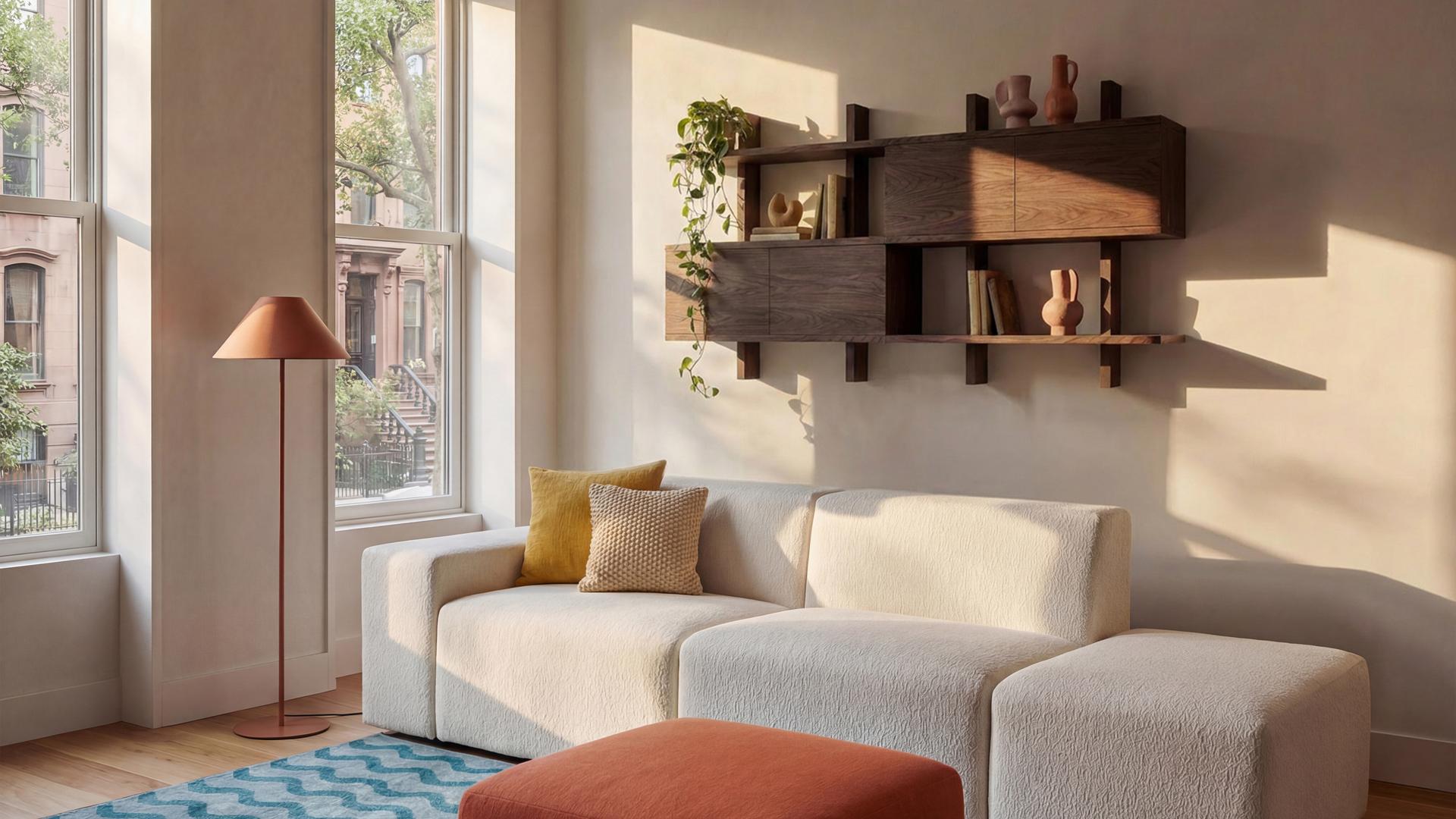
Short answer: Cozey's Themis and Altitude are both 32.0 inches wide, but Themis is 11.0 inches deep, holds 50 lb per unit and can stand on the floor, while Altitude is 9.5 inches deep and wall-mounted only.
Both systems are modular, and both let you mix open shelves with closed storage, so the choice comes down to depth, mounting, load and whether you need a desk. This page puts the two side by side and links the full guide to each one. To plan a whole wall, read our guide to planning a shelving wall.
On This Page
- How do Themis and Altitude compare at a glance?
- Which system is shallower, and does it matter?
- Which units does each system include?
- Should I choose a wall-mounted or a freestanding system?
- How much weight can Themis and Altitude hold?
- Which finishes does each system come in?
- Can I use Themis and Altitude on the same wall?
- How do Themis and Altitude work with Cozey Studio and our sofas?
- Our recommendation
- Explore our wall storage
How do Themis and Altitude compare at a glance?
At Cozey, we make Themis and Altitude as two separate collections, and every figure below comes from the product pages and our product guides.
How do Themis and Altitude compare at a glance?
| Themis | Altitude | |
|---|---|---|
| Depth | Shelf and cabinet 11.0 inches; desk 17.0 inches | Shelf set and cabinet 9.5 inches |
| Width | 32.0 inches for every unit | Shelf set 32.0 inches; cabinet 32.1 inches |
| Height of one unit | 24.0 inches | Shelf set 32.0 inches; cabinet 9.8 inches |
| Pieces | Shelf, cabinet with sliding doors, desk | Shelf set and a storage cabinet with a magnetic push latch |
| Mounting | Shelf and cabinet wall-mounted or freestanding; desk wall-mounted only | Wall-mounted only |
| Weight | 50 lb per shelf, cabinet or desk | Not published on the product page |
| Finishes | Oak, Walnut or Dove, with Canary or Eucalyptus back panels and doors | Walnut, Oak, Black wood or Dove |
| Assembly | About 45 minutes per unit, plus about 40 minutes for wall anchoring or freestanding setup | About 40 minutes per shelf set and 20 minutes per cabinet |
Themis suits a wall that may change, a work corner or a bit of color. Altitude suits a narrow wall where every inch of depth counts.
Which system is shallower, and does it matter?
Altitude is shallower: our Altitude shelf and storage cabinet are 9.5 inches deep, while the Themis shelf and Themis cabinet are 11.0 inches deep. That is a difference of 1.5 inches, and the Themis desk is deeper again at 17.0 inches.
Depth matters most in hallways, behind a door and beside a sofa. As a general guideline, keep walking paths at least 30 inches wide, and 36 inches where people pass often, then subtract the depth of the unit from the floor you have. Tape the footprint on the floor before you order.
Which units does each system include?
Themis has three units of the same width and height, and Altitude has a shelf set with a cabinet that slides into it. The two systems work differently:
- Themis shelf: open storage, 32.0 x 11.0 x 24.0 inches, with an optional Canary or Eucalyptus back panel.
- Themis cabinet: the same size, with two sliding doors, each 15.7 inches wide, in Oak, Walnut or Dove, or with Canary or Eucalyptus doors.
- Themis desk: the same width and height but 17.0 inches deep, for a laptop or notebook, and wall-mounted only.
- Altitude shelf set: three shelves held between two vertical supports, 32.0 x 9.5 x 32.0 inches.
- Altitude storage cabinet: 32.1 x 9.5 x 9.8 inches, a closed box that clips in between two Altitude shelves and opens with a press.
A Themis cabinet is a full unit that works on its own. The Altitude cabinet is a smaller insert that fills one opening and needs an Altitude shelf to sit in, so it hides the router and chargers while the shelves around it stay open. Altitude has no desk. Our Themis guide and Altitude guide cover each piece in full.
Should I choose a wall-mounted or a freestanding system?
Choose Themis if you want the option to stand on the floor, because our Themis shelf and cabinet can be hung on the wall or stood on felt pads. A freestanding unit still needs a wall behind it: the box includes anti-tip brackets and a security cable, and the bracket is fastened to a stud. The Themis desk and every Altitude piece are wall-mounted only.
Choose Altitude if you are happy to hang it. Its box includes keyhole plates, M6 screws, wall anchors, an acrylic spacer, a hex Allen key and a mounting poster that serves as the template. If you stack or join several units, hang the bottom one first. Because the same Themis pieces work both ways, a wall setup can later become two freestanding side tables or low credenzas if you move. If you cannot fix anything to your wall, neither system is an easy fit. In a rental, check the building rules before drilling.
How much weight can Themis and Altitude hold?
Each Themis shelf, cabinet or desk holds 50 lb, and that limit applies to each unit rather than to the whole stack. We do not publish a weight capacity for Altitude on its product page, so we do not give a figure. If you plan to load Altitude with heavy books, ask our Customer Happiness team before you hang it.
As general advice, put the heaviest items on the lowest unit, and remember that a wall-hung shelf is only as strong as the wall behind it. Check your wall type and use the supplied anchors, or fix into a stud, before loading anything heavy.
Which finishes does each system come in?
Themis comes in Oak, Walnut and Dove, and Altitude comes in Walnut, Oak, Black wood and Dove on our US pages. Themis adds two accent colors, Canary and Eucalyptus, on the shelf back panel and the cabinet doors. Each colored panel is reversible with Dove on the other side, and a colored panel pairs with an Oak or Walnut frame.
The materials differ. Themis uses an ash wood frame with MDF panels and a thin real wood veneer in Oak and Walnut, and Dove is painted. Altitude shelves are solid ash, stained in Walnut, Oak and Black wood and painted in Dove, while the cabinet panels are MDF with a 0.01 inch veneer. Oak, Walnut and Dove appear in both systems, and Oak and Walnut are also on our Aurora credenza, so a shelf wall and a media wall can share a tone. Colors look different on a screen, so judge them in your own light.
Can I use Themis and Altitude on the same wall?
They are separate collections, so keep each system together. The Altitude cabinet is designed to fit an Altitude shelf and is not a Themis module, and the two systems differ in depth (11.0 and 9.5 inches) and in unit height (24.0 and 32.0 inches). Mixing them on one wall would leave uneven edges.
Using one system on each wall of a room works well. For example, Altitude can run beside the sofa for books and plants while a Themis desk and cabinet fill a work corner on the next wall. Our home office corner guide shows Themis desk layouts.
How do Themis and Altitude work with Cozey Studio and our sofas?
Both systems can be laid out before you order. We first piloted Cozey Studio, our 3D configurator, with Themis and Altitude, because storage needs are specific: one person wants cabinets in the top row, and another wants open shelves, on the same footprint. Our Studio guide explains how the sofa version works, and you can try your wall layout in the configurator on each product page.
A shelf wall sits best beside a sofa that fits the room. Our collections are Ciello (one of our softest sofas, with deep, loose cushions), Gaia (a soft seat with a high backrest and slim arms), Cassini (curved and low) and Atmosphere (medium-firm, with our deepest seat), and our sofa beds are Neptune and Orian. Read which Cozey sofa is right for you to choose.
Our recommendation
Cozey's Themis is the better choice when you want a desk, a freestanding option, a published load rating or color, and Altitude is the better choice for the shallowest wall storage.
- A narrow hallway or the wall beside a sofa: Altitude, one shelf set or a horizontal pair, with a cabinet to hide small items.
- A work corner: Themis, one desk and one cabinet in Oak or Walnut.
- A wall that may change, or a rental you may leave: Themis shelves and cabinets, which can come off the wall and stand on the floor.
- Heavy books: Themis, because it states 50 lb per unit.
- A calm look: Dove in either system.
Explore our wall storage
- Shelves
- Modular cabinets
- Modular desks
- Themis collection
- Themis guide
- Altitude guide
- Planning a shelving wall
- Living room storage
- Cozey Studio
More Cozey comparisons: Bookcase or Wall Shelving for a Living Room.
Product specifications can change. Check the current dimensions on the product page before ordering.