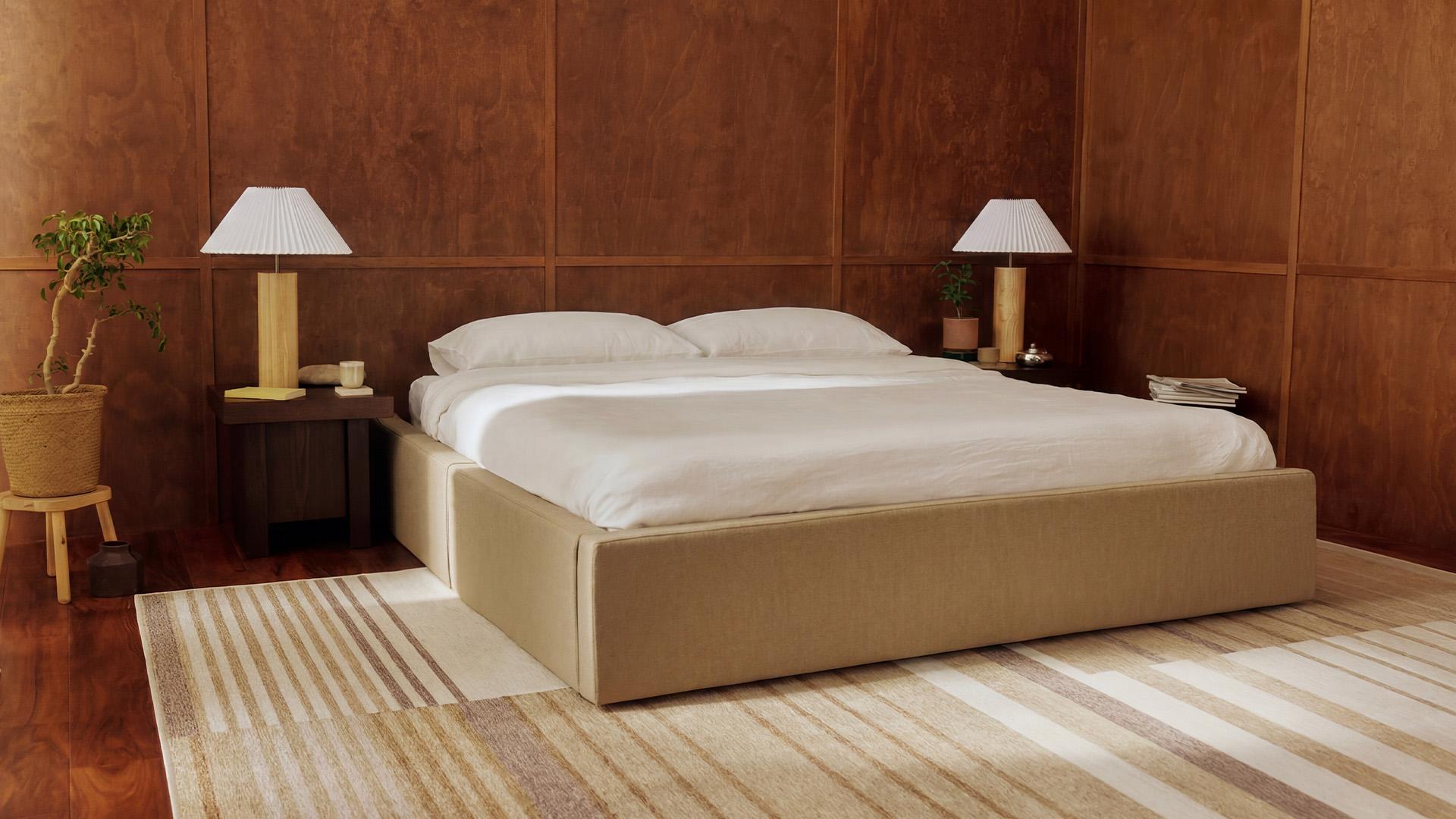
Short answer: The palettes that feel calmest keep contrast low and use two or three close tones. On our Ara bed, the calmest headboard colors are the soft neutrals: Snowdrift, Cloud, Flax Haven, Silken Sand and Crumble. Cobblestone and Sage give a muted, grounded room, and Espresso gives a dark, cozy one. Walls, bedding and the wood already in your room then repeat the same family of tones.
Color in a bedroom is mostly about what your eye does when you walk in. A bed with a strong contrast against the wall pulls the eye, and a bed that sits close to the wall tone lets it rest. The sections below show how to build that, one layer at a time.
On This Page
- What makes a bedroom palette calm?
- Which Ara headboard colors are calming?
- How does wood in the room change the palette?
- Three calm palettes you can copy
- How do you choose wall and bedding colors?
- Which palette suits your room?
- Our recommendation
- Explore our bedroom range
What makes a bedroom palette calm?
A calm palette is built from a few rules, and all of them are general design practice rather than product facts.
- Low contrast: choose a headboard, walls and bedding that sit within a step or two of each other in lightness.
- Two or three tones: one main color, one supporting color and one accent is enough. More than that and the room starts to compete with you.
- Soft, low-saturation color: muted shades read as quiet, while bright, saturated ones read as lively.
- Texture instead of color: a chenille headboard against smooth bedding adds depth without adding another hue.
- Light that is warm in the evening: a color looks different under daylight and under a lamp, so judge it in both.
Our guide to the best fabric for an upholstered headboard covers durability and cleaning for each Ara fabric, so this article stays on color.
Which Ara headboard colors are calming?
The Ara bed comes in eight fabric colors. We describe them using the wording already on our guides, and we group them here by mood.
- Light and airy: Snowdrift is a clean white, and Cloud is a warm white. Cloud is a bouclé rated at 15,000 Martindale rubs, and we advise spot cleaning it to maintain its look.
- Warm and soft: Flax Haven and Silken Sand are light warm neutrals in Performance Natural Weave, rated at 18,000 Martindale rubs. Crumble is a soft, warm greige in Aquaforte Velvet, rated at more than 200,000.
- Muted and grounded: Cobblestone is a mid gray and Sage is a deep green, both in Performance Chenille, rated at 48,000 Martindale rubs.
- Dark and cozy: Espresso is a very dark brown, also in Performance Chenille.
Lighter fabrics show marks more easily. If the bed is shared with pets or kids, choose a washable cover, and read our guide to bed frames for pets and kids. For the headboard shapes and frames that go with these colors, see our Ara customization guide.
How does wood in the room change the palette?
Our Ara bed is upholstered, so the wood in your bedroom comes from the floor, a dresser or the nightstands. Wood brings warmth that fabric cannot, and the headboard works best when it agrees with it. A warm wood floor sits easily with warm neutrals such as Flax Haven, Silken Sand or Crumble, and a cooler or grayer floor suits Cobblestone or a clean Snowdrift.
You do not need to match the wood exactly. Aim for one dominant wood tone in the room and repeat it once or twice, rather than mixing three. If you love the look of a deep brown, our guide to brown beds covers Espresso, and our green beds guide covers Sage.
Three calm palettes you can copy
Each row below uses only colors that appear on our Ara page. Walls and bedding are described by mood, because we do not name paint colors.
Three calm palettes you can copy
| Palette | Headboard | Frame | Bedding | Wall mood |
|---|---|---|---|---|
| Light and airy | Cloud or Snowdrift | Round or Square upholstered frame | Warm white and flax-toned linen | Soft warm white |
| Warm and earthy | Flax Haven, Silken Sand or Crumble | Round or Square upholstered frame | Sand, oatmeal and cream | Pale greige |
| Muted and grounded | Sage or Cobblestone | Round or Square upholstered frame | Off-white, with one softer accent | Quiet light neutral |
For a dark, cozy room, use Espresso as the single dark note and keep everything else warm and quiet.
How do you choose wall and bedding colors?
Start with the headboard, because it is the largest block of color you will choose. As general advice, not a product specification, keep the walls within a step or two of its lightness, and let the bedding sit between the two.
- Walls: low-saturation shades with a matte or soft finish reflect less glare. Test a sample on the wall and look at it at morning, noon and night.
- Bedding: keep it in one color family and add one softer accent, such as a throw. Smooth linens against a textured headboard keep the room from looking flat.
- Floor and wood: repeat a tone you already own. If the floor is warm, choose a warm headboard, and if it is cool, a gray such as Cobblestone sits more easily.
Which palette suits your room?
Which palette suits your room?
| Your room | A good direction | Why |
|---|---|---|
| Small or dim | Snowdrift, Cloud or Silken Sand | Light colors keep the bed from feeling heavy |
| Lots of daylight | Most colors, including Espresso | Daylight keeps a dark headboard from feeling heavy |
| Lamp-lit evenings | Warm neutrals such as Flax Haven or Crumble | Warm light flatters warm tones |
| Pets or kids | A washable cover in Crumble or Cobblestone | A washable cover and a mid tone tend to hide everyday marks |
These are suggestions, and the best palette is the one that feels restful to you in your own light. Free swatches let you hold the fabric next to your walls and bedding before you order.
Our recommendation
Pick the mood first, then the color.
- Choose Snowdrift or Cloud for a light, airy room.
- Choose Flax Haven, Silken Sand or Crumble for a warm, soft room.
- Choose Cobblestone or Sage for a muted, grounded room.
- Choose Espresso for a dark, cozy room with plenty of daylight or warm lamps.
Order swatches for your top two, and decide in the room itself.
Explore our bedroom range
Product specifications can change. Check the current dimensions on the product page before ordering.