Short answer: A modular sofa is worth it if your space, household or taste is likely to change, or if you want to wash or replace parts instead of the whole sofa. It is less compelling if you want one seamless frame that you will never rearrange. The trade-offs are real: visible seams between modules, a little assembly, and some cushion care on the softest collections.
Most people ask this question while comparing a modular sofa with a traditional one. The better question is what you will want from the sofa in five or ten years, because that is where the two types differ most.
On This Page
- What do you get from a modular sofa?
- What do you give up?
- Modular vs traditional: how the two compare
- Does a modular sofa pay off over time?
- Who is a modular sofa right for?
- Who is a modular sofa not right for?
- How to buy a modular sofa online without regrets
- Our recommendation
- Explore our modular sofas
What do you get from a modular sofa?
A modular sofa is built from separate seats, corners, arms, chaises and ottomans that connect together. Our guide to modular sofas explained covers the basics, so here is what that design means in daily life.
- A shape you choose. Each of our collections, including Gaia, Ciello, Atmosphere, Cassini, Neptune and Orian, can be built as an L-shape or a U-shape, and most can also be a straight sofa with a chaise or ottoman.
- Room to grow. You can start with a two-seater and add modules later, within compatible collections and configurations.
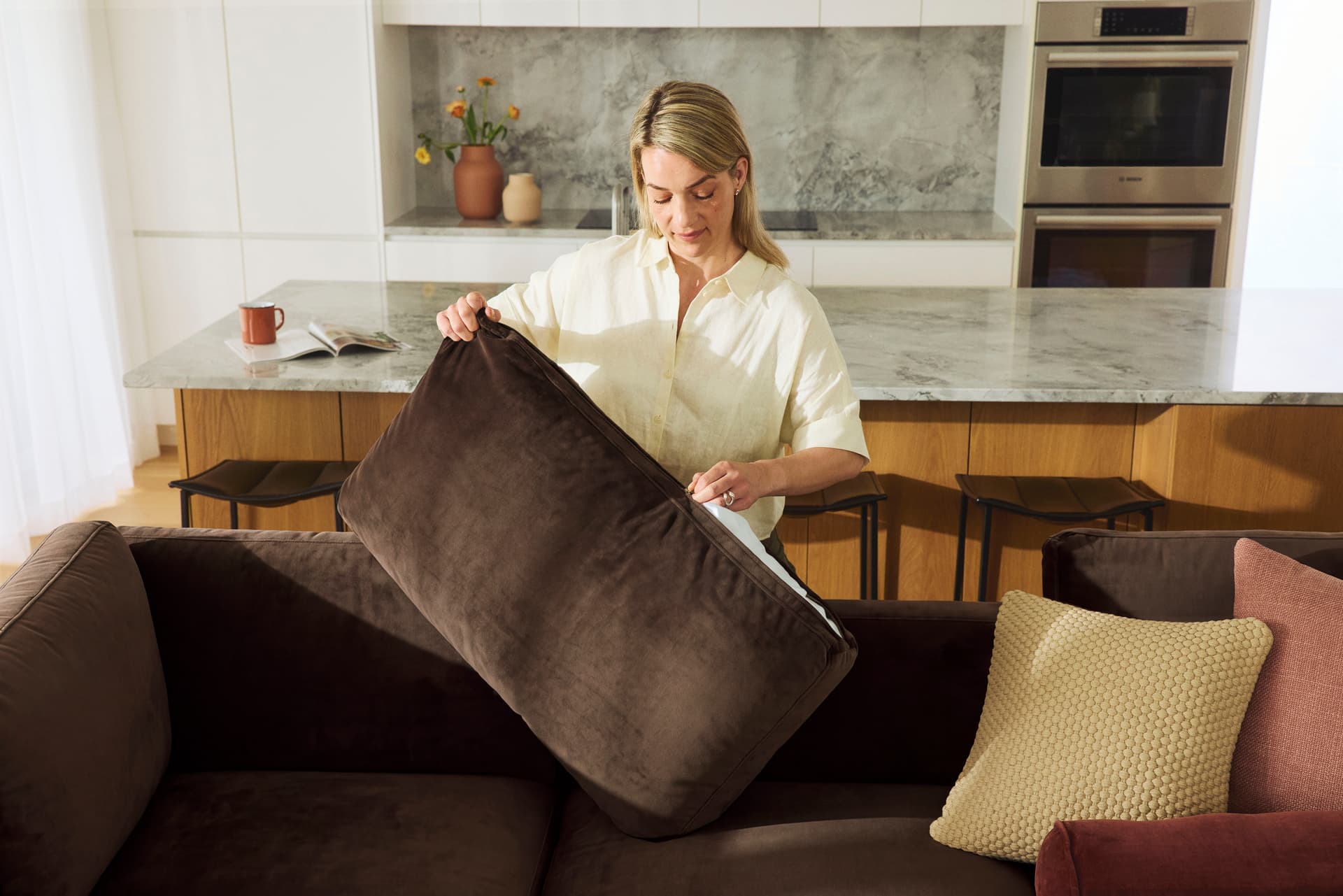
- Parts you can replace. On compatible collections you can buy replacement covers or modules rather than a new sofa.
- Easier delivery. Modules ship in separate boxes. The longest indoor sofa box we list is 41.7 inches, and a Gaia armless seat box is 32.5 x 32.5 x 12.6 inches. That helps with walk-ups, tight stairs and small elevators. Our stairs, elevators and doorways guide shows how to check your route.
- Built-in options. Some collections add storage or a sleeper: Neptune and Orian are sofa beds, and Atmosphere has storage and sleeper modules.
What do you give up?
A fair answer includes the downsides. These are the ones we would want you to know before you order.
- Visible seams. Separate modules mean a join between seats and backrests. We add foam around those junctions to soften them, and on Ciello and Gaia we added a further 1.5 inches of D35 foam to the base. No modular sofa feels perfectly seamless in every position.
- A little movement. Connectors and non-slip feet hold modules together, but some slight movement between modules can still happen.
- More boxes to assemble. Setup is tool-free on several collections and takes about 20 minutes per module for Atmosphere, Ciello, Gaia and Neptune, so a five-module sofa takes longer than a one-piece sofa.
- Cushion care. Our soft Ciello and Gaia loose cushions need regular fluffing to keep their shape. Atmosphere, Cassini, Orian and Neptune use layered-foam seating that keeps a more consistent feel with less maintenance.
- Compatibility limits. Not every module fits every collection or every product generation. Regular, storage and sleeper Atmosphere modules cannot be mixed in one sofa, and Gaia Regular and XL sizes cannot be mixed either. Check compatibility before you add modules.
- Fixed parts on some models. On Neptune and Orian, the arm and base covers are fixed, although the seat and back cushion covers come off.
Modular vs traditional: how the two compare
This table compares the two types on ownership questions, not on price. We do not make price claims here because prices change by product, fabric and layout.
Modular vs traditional: how the two compare
| Question | Modular sofa | Traditional one-piece sofa |
|---|---|---|
| Changing the layout later | Add, remove or rearrange compatible modules | The shape stays the same |
| Moving to a new home | Rebuild it to suit the new room | It fits the new space or it does not |
| Delivery to a tight space | Separate boxes, each one carried on its own | Often one large piece |
| Replacing a worn part | Replacement covers or modules for compatible collections | Often the whole sofa |
| Seamless look | Seams between modules | Usually continuous |
| Assembly | Per-module setup | Often none, or very little |
The traditional sofa is not a bad choice. It wins on the seamless look and on zero assembly, and it is the simpler decision if the room and household will stay the same.
Does a modular sofa pay off over time?
Value shows up over the life of the sofa, so it helps to look at how long each part should last. Here are our design expectations, not guarantees. Actual life depends on use, environment, care and the collection.
- Frame: designed for more than 20 years of use.
- Cushions and covers: roughly 5 to 10+ years for Ciello and Gaia cushions, and roughly 7 to 10 years for layered-foam seating and fabric covers.
- Whole sofa: built to last 7 to 10+ years with proper maintenance, and 10 to 15 years if you swap cushions, covers or modules instead of buying a new sofa.
Each seat is rated for 350 lb for everyday use, and our sofas carry a five-year limited manufacturing warranty, subject to the terms. Our guide on how long our sofas last explains each part in more detail.
A modular sofa pays off most when something changes: you move, add a seat, adopt a dog or want a new color. If nothing ever changes, the extra flexibility sits unused, and the value comes mainly from the comfort, the covers and the build. For a broader look at how we think about cost, see are Cozey sofas worth the money.
Who is a modular sofa right for?
Modular tends to suit these situations well.
- Renters and frequent movers. Boxed modules go through narrow doors and stairs, and you can rebuild the sofa to fit the next room.
- Small spaces. You choose the module count. A Ciello two-seater with a chaise is 74.75 x 68.5 inches, the Gaia compact armless layout is 65.4 x 65.4 inches, and a compact Cassini L fits within roughly 62.5 inches on each side.
- Growing or changing households. Start small and add seats.
- Homes with pets or kids. Removable covers on Ciello, Gaia, Atmosphere and Cassini make cleaning easier, and fabrics such as Aquaforte Velvet, at more than 200,000 Martindale, have been tested to more than 200,000 Martindale rubs. Our washable sofas for pets and kids guide compares the options.
- Guests. A sleeper or storage module turns the sofa into a spare bed or a place for linens.
Who is a modular sofa not right for?
It is not the best match for everyone, and saying so helps you choose.
- You want a perfectly continuous look. A fixed one-piece sofa has no module joins.
- You will never change the layout. Then you pay in assembly time and seams for flexibility you do not use.
- You dislike assembling furniture. Each module needs setup, even when it is tool-free.
- You want to try the exact sofa first. Measurements and fabric swatches help, but they are not the same as sitting on it.
How to buy a modular sofa online without regrets
A few steps lower the risk, and our guide to buying a sofa online vs in store goes deeper.
- Order fabric swatches and look at them in your own light. See our swatches.
- Mark the footprint with painter tape and live with it for a day.
- Check seat depth against a sofa you already find comfortable. Our collections differ in softness and depth, so compare the seat depth listed on each product page.
- Measure the route in, using the box sizes above.
Our recommendation
- Pick a modular sofa if you move, rent, host guests, have pets or kids, or expect your household to change.
- Pick Gaia or Ciello if you want a soft, deep seat and are happy to fluff the cushions.
- Pick Atmosphere or Cassini if you want layered-foam seating with less cushion upkeep.
- Pick Neptune or Orian if the sofa must also be a bed.
- Pick a traditional sofa if the layout will not change and you want the most seamless look.
If you are still unsure, how many modules do you need is the next step, and you can book a free design consultation to talk through your room.
Explore our modular sofas
Product specifications can change. Check the current dimensions on the product page before ordering.