Your Cart

There are no items in your cart.

Guides

Dining Table Materials: Solid Wood, Veneer and What Lasts

What your dining table is actually made of, how veneer and solid wood differ, and how our Vela and Ushi tables are built.

Updated 30 October 20263-min ReadFred Aubé, CEO
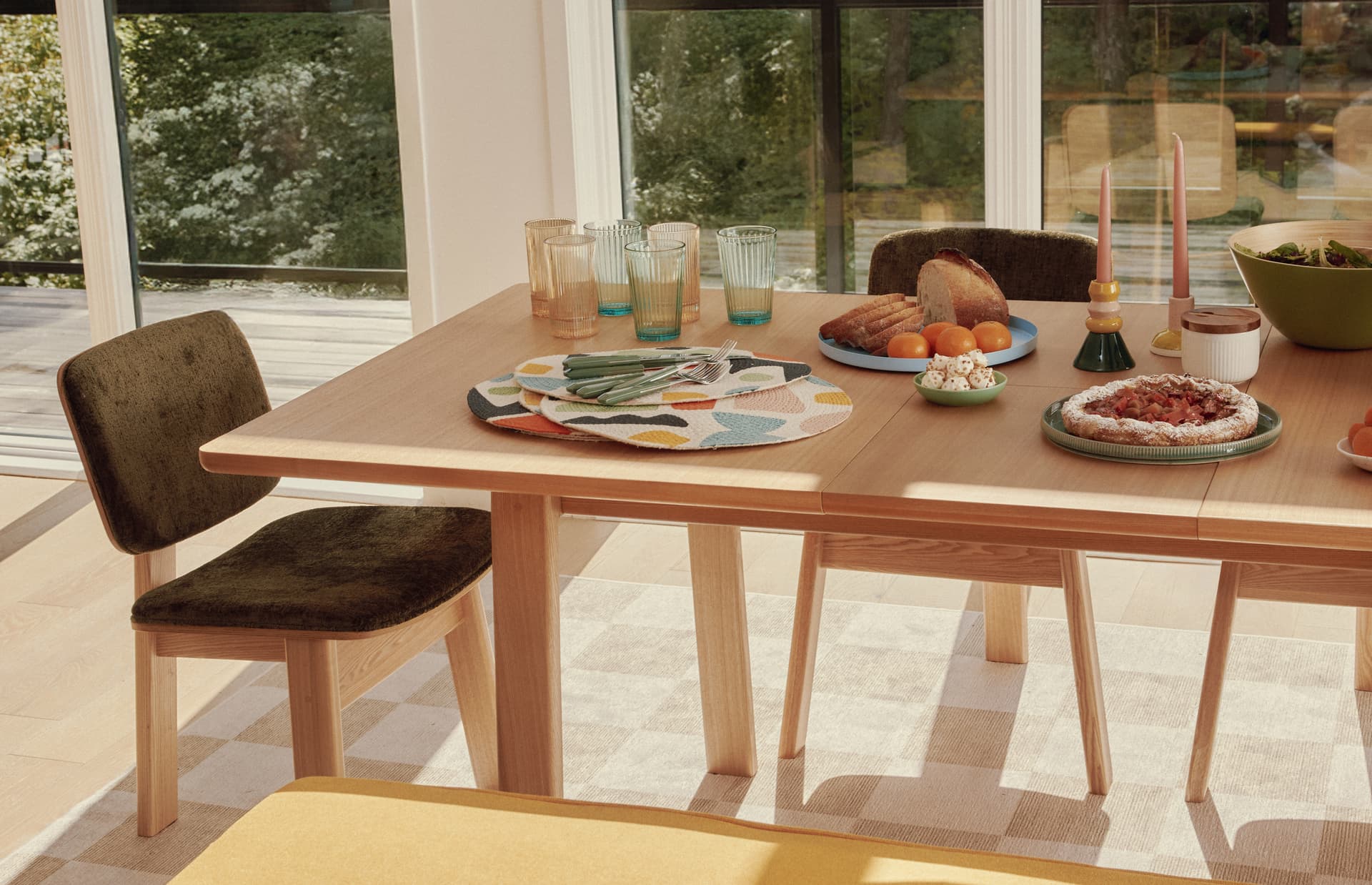
A Vela dining table in a home dining room

Short answer: A durable dining table is about construction, finish and care, not only whether it is made of solid wood. Our Vela and Ushi tabletops are lacquered wood veneer over MDF, and their frames and legs are ash wood.

Many tables use the words "wood" or "solid wood" loosely. Here is what the terms mean and how to read a product description.

On This Page

  1. What is wood veneer?
  2. What is solid wood?
  3. How Cozey tables are made
  4. Heat and scratch resistance
  5. Is veneer worse than solid wood?
  6. Caring for a wood dining table
  7. Choosing a table
  8. Explore Cozey dining

What is wood veneer?

Wood veneer is a thin sheet of real wood applied to a supporting panel. In our tables the panel is medium density fibreboard (MDF), and the veneer is about 0.3 mm thick on the Vela and Ushi tabletops. The veneer provides the natural grain and appearance of the wood. The MDF underneath gives the panel its flat, stable structure.

What is solid wood?

Solid wood is made of wood through its full thickness. It can often be sanded and refinished, depending on its finish and construction. A table described as "solid wood" should be solid throughout the part being described, which is why we are specific about which parts of each table are solid ash and which are veneer.

How Cozey tables are made

How Cozey tables are made

TableTabletopFrame and legs
Vela15 mm MDF with 0.3 mm wood veneer, lacqueredAsh wood, satin stain
Ushi15 mm MDF with 0.3 mm wood veneer, lacqueredAsh wood, satin stain

The MDF panels are TSCA Title VI compliant, a standard for formaldehyde emissions from composite wood.

Heat and scratch resistance

We don't list heat or scratch ratings for the Vela and Ushi tabletops, so treat them like any finished wood surface: keep using trivets for very hot pans and avoid dragging heavy or sharp objects across the table.

Is veneer worse than solid wood?

Not automatically. Veneer and solid wood have different strengths. Veneer over a stable panel gives a consistent surface, and solid wood can often be refinished. The right choice depends on how you use the table, how you maintain it and what you want to see and feel. We prefer to describe materials exactly rather than rely on vague phrases like "solid wood look".

Caring for a wood dining table

  • Dust with a soft, dry cloth.
  • Wipe spills quickly. For stains, use a damp cloth with mild soap, then dry right away.
  • Avoid harsh cleaners, which can damage the finish.
  • Use coasters and trivets to protect the finish from heat and moisture rings.

This is general care advice for finished wood. Check the product page for the specific care instructions for your table.

Choosing a table

  • Everyday family use: look for a durable finish and an easy-to-clean surface, and check whether the maker lists heat and scratch resistance.
  • Hosting often: an extendable table gives you length when you need it. Read our dining table size guide.
  • Small spaces: see our guide to compact dining sets.

Explore Cozey dining

Product specifications and materials can change. Check the current details on the product page before ordering.

Frequently Asked Questions

It depends on the table and the part you mean. The Vela and Ushi tabletops are lacquered wood veneer over 15 mm MDF, with a veneer about 0.3 mm thick, and their frames and legs are ash wood. The veneer is real wood and gives the tabletop its natural grain, while the MDF panel underneath gives it a flat, stable structure. We describe each part exactly rather than use a loose phrase like "solid wood", because a table described as solid wood should be solid throughout the part being described.


Wood veneer is a thin sheet of real wood applied to a supporting panel. In our tables the panel is medium density fibreboard (MDF), and the veneer is about 0.3 mm thick on the Vela and Ushi tabletops. The veneer provides the natural grain and appearance of the wood, while the MDF underneath gives the panel its flat, stable structure. Veneer is not automatically worse than solid wood: it gives a consistent surface, while solid wood can often be sanded and refinished. The MDF panels are TSCA Title VI compliant, a standard for formaldehyde emissions from composite wood.


We don't list a heat resistance rating for the Vela and Ushi tabletops, which are lacquered veneer over MDF, so treat them like any finished wood surface. Keep using trivets for very hot pans, and use coasters to protect the finish from heat and moisture rings. Hot cookware set directly on a finished wood surface can leave marks, so a trivet is the simplest precaution. For care, wipe spills quickly and avoid harsh cleaners, and check the product page for the care instructions for your table.


We don't list a scratch resistance rating for the Vela and Ushi tabletops, which are lacquered veneer over MDF, so treat them like any finished wood surface. Everyday use with plates, cutlery and cookware is what a dining table is for, but avoid dragging heavy or sharp objects across it. As general advice, a placemat or protective pad under hard-surface work such as crafts is a sensible precaution on any finished wood table.


Our dining tables use ash wood. The Vela and Ushi tabletops are lacquered wood veneer over MDF, and their frames and legs are ash wood with a satin stain. Wood veneer is a thin sheet of real wood applied to a supporting panel, here a 15 mm MDF panel with a veneer about 0.3 mm thick, and it gives the table the natural grain of the wood. Check the product page for the finishes currently offered, because specifications and materials can change.


Dust with a soft, dry cloth, and wipe spills quickly. For stains, use a damp cloth with mild soap, then dry right away so water does not sit on the finish. Avoid harsh cleaners, which can damage the finish, and use coasters and trivets to protect it from heat and moisture rings. This is general care advice for finished wood, so check the product page for the specific care instructions for your table.

Explore Cozey's Dining

Shop Dining Today