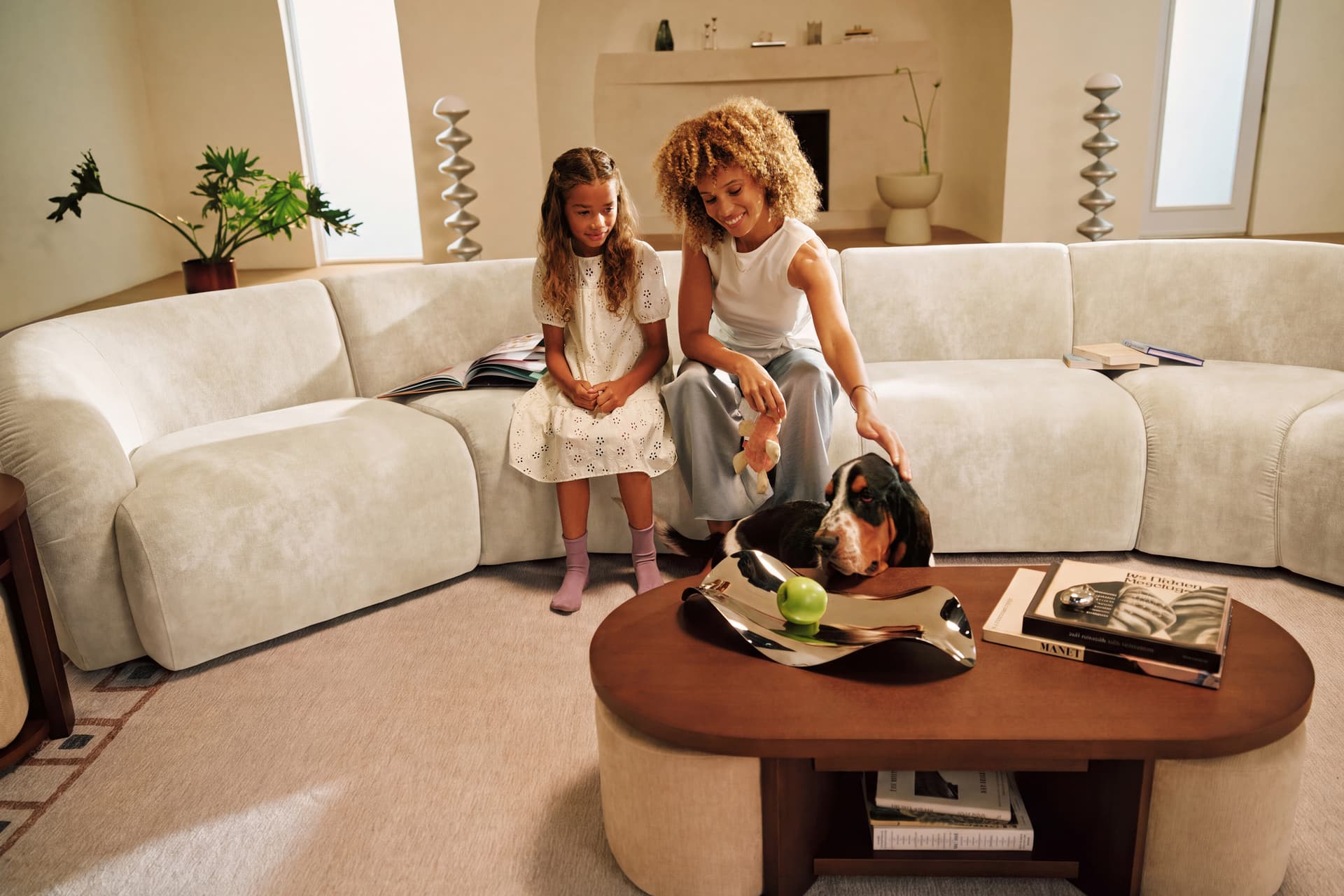
Short answer: There is no single rule for an open-plan living room, so start with how you live. We recommend defining the living zone with a rug, bringing the furniture off the walls where the room allows, and choosing pieces that do more than one job, such as a storage sofa or a storage ottoman. For hosting, we prefer two sofas facing each other.
An open floor plan has no walls to tell you where the living room starts and stops, so the furniture has to do that job. The tips below are general and flexible: they are meant to help you make decisions, not to hand you a formula.
On This Page
- Why are open-plan living rooms tricky to arrange?
- How do I define zones in an open-plan room?
- Why should I bring furniture off the walls?
- Which layouts work best for hosting and conversation?
- How much space should I leave around furniture?
- How do small and large rooms change the layout?
- How can multi-purpose furniture reduce clutter?
- How do I choose the right rug size?
- What if guests sleep over in the living room?
- Our recommendation
- Explore our living room range
Why are open-plan living rooms tricky to arrange?
One large space has to do several jobs at once: lounging, hosting, perhaps eating or working nearby. Without walls, a sofa pushed against the edge of the room can leave the middle empty, and a room full of unrelated pieces can feel scattered. The aim is to give each activity a clear place, so the room reads as a set of calm zones instead of one big floor.
Our guide to which sofa configuration fits your living room is a helpful companion if you want to compare layouts.
How do I define zones in an open-plan room?
Use three simple tools together. None of them needs a wall.
- A rug. A rug is the easiest way to mark where the living room begins. It pulls the seating into one group and separates it from the kitchen or dining area. Using a different rug in each zone also makes the layout easier to read. See our washable rugs for the range.
- The back of a sofa. A sofa has a clear front and back, so turning its back toward the dining table or the entrance works as a soft divider.
- Storage pieces. A low unit such as our Aurora credenza behind or beside the seating creates an edge without blocking sight lines. Our guide to living room storage has more ideas.
Why should I bring furniture off the walls?
In most rooms, floating furniture away from the walls looks better. It lets the space breathe and adds depth and dimension, because you can see the room around each piece instead of a line of furniture pushed against the edges. It also helps to create zones: a sofa that sits a little way into the room, with a rug underneath, quickly becomes its own area.
This does not mean everything has to float. A wall is still a sensible place for tall storage or a TV if that is how you use the room. Our sofas can also sit against a wall when the space is tight, so let the size of the room guide you.
Which layouts work best for hosting and conversation?
All of the common layouts can work: a sofa with chairs, an L-shaped sectional, a U-shape, or two sofas facing each other. Which one suits you depends on the room and on how you entertain.
- Two sofas facing each other. This is our preference for hosting. It leaves more room to move around and makes serving food and drinks easier, and everyone can see each other.
- L-shape. An L wraps two sides of the group and uses a corner. It is versatile, because it is also a great layout for lounging on a quiet night.
- U-shape. A U-shape holds a large group around a central table and also makes a generous lounging space. It suits a larger room.
- Sofa plus chairs. A sofa with one or two lounge chairs facing it is easy to adjust, because chairs can be pulled in for guests and moved back afterward. Browse our lounge chairs for options.
Our guide to pairing a sofa, an accent chair and a coffee table shows how these pieces work together.
How much space should I leave around furniture?
We suggest a few simple guidelines, and they are guidelines, not rules.
- Walking paths: plan at least 30 inches of clearance for a path people walk along. This does not apply between all pieces of furniture. An accent chair beside a sofa, where nobody needs to walk between the two, does not need 30 inches.
- Sofa to coffee table: leave at least 14 inches. There is no maximum. It depends on the size of the room and the layout. With two sofas facing each other, the table can sit farther from each sofa, and a couple of side tables will hold glasses and plates.
- TV: the TV is not a decor item, so we do not apply distance rules to it. Placement depends on the layout, and the size of the TV determines how far it can sit from the sofa.
These are general advice, not a product specification.
How do small and large rooms change the layout?
The balance between seats and surface area depends entirely on the room and on your preferences. Some people want as many seats as possible, and others want open floor.
In a smaller room, we generally find that Gaia and Neptune are a bit more compact than our other collections, so they fit more seats into a smaller surface area. Our guide to compact sectionals for small spaces goes into more detail. If you prefer deep seating and storage, an Atmosphere two-seater is a great option.
In a larger room, an L-shape or a U-shape fills the space and gives you several places to sit. Whatever the size, our sofas are modular, so you can start with a layout and add modules later, where the collection allows it. Ciello also has deep seats for lounging. Our guide to sofas for small apartments and condos is helpful for condos and lofts.
How can multi-purpose furniture reduce clutter?
An open room shows everything at once, so hidden storage is worth planning for. A storage sofa or a storage ottoman keeps blankets, remotes and toys out of sight, and it keeps the room tidy without adding another piece to the floor.
How can multi-purpose furniture reduce clutter?
| Collection | Storage pieces |
|---|---|
| Neptune | Built-in storage in each seat, and a storage ottoman |
| Atmosphere | Storage in each module, as well as in the regular and long ottomans |
| Ciello | A storage ottoman and hidden storage |
Our guide to storage ottomans that double as seating shows how an ottoman can serve as a footrest, an extra seat and storage at once.
How do I choose the right rug size?
Our washable rugs come in 5 by 8 feet, 8 by 10 feet and 9 by 12 feet. For a large sectional or a U-shape, we recommend the biggest size, so the whole seating group sits on the rug. The smallest size only suits two sofas facing each other, with the rug centered between them. Our rug size guide walks through each room.
What if guests sleep over in the living room?
In an open-plan home, the living room often doubles as the guest room. A sleeper sofa such as Neptune can double as a guest bed, and its seats include storage for bedding. Neptune also offers an optional ottoman. Read our guide to the best sofa beds to compare choices, or browse our sofa beds.
Our recommendation
There is no single rule, so choose the layout that suits your lifestyle.
- You host often: two sofas facing each other, with side tables for glasses, and a large rug centered between them.
- You like to lounge: an L-shape or a U-shape, with the largest rug that fits, so the whole group sits on it.
- Your room is small: a compact collection such as Gaia or Neptune, with a storage ottoman and a rug to mark the zone.
- You want deep seating and storage: an Atmosphere two-seater, floated off the wall.
- You have overnight guests: a Neptune sleeper, with its built-in storage for bedding.
- Not sure: talk it through with us. A free design consultation can help you plan the room: book a consultation.
Explore our living room range
Product specifications can change. Check the current dimensions on the product page before ordering.