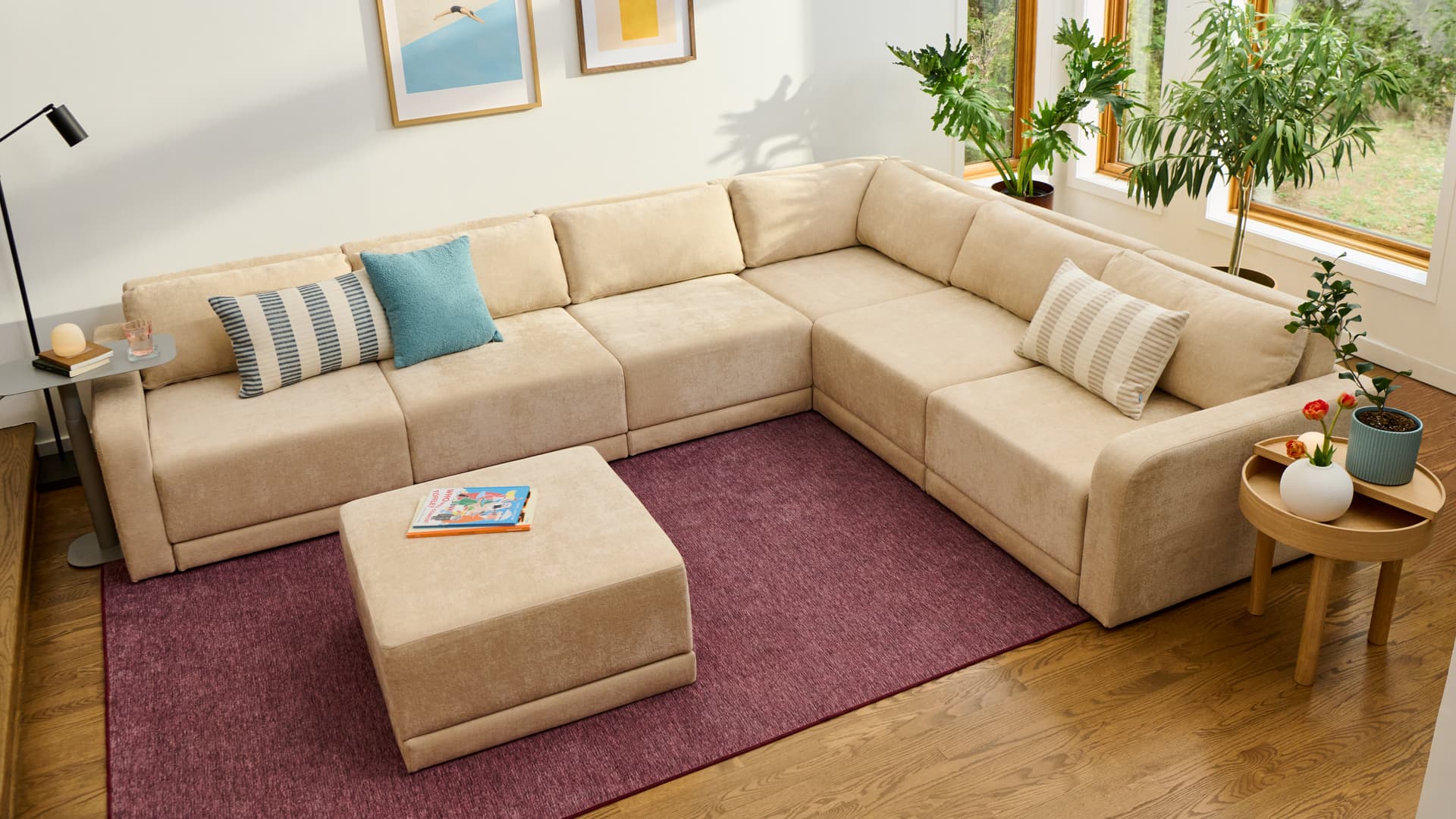
The short answer: A small L-shaped sectional can fit well under 90 inches (229 cm) on each side. Two confirmed Cozey examples are a Cassini armless one-seat–corner–one-seat layout measuring about 62.5 × 62.5 inches (159 × 159 cm) and a comparable Gaia armless corner layout measuring about 65.4 × 65.4 inches (166 × 166 cm). If you prefer a longer sofa with one forward lounging extension, Ciello's two-seater with chaise is 74.75 inches wide by 68.5 inches deep (190 × 174 cm), although a chaise sofa isn't quite the same as a corner sectional.
When a space is small, it can seem counterintuitive to choose a sectional. But an L-shaped design often follows two walls more efficiently than adding separate chairs. The key is to compare both legs of the L, not simply the longest width stated in a product name.
On This Page
- The small sectionals worth measuring first
- Best for the smallest true L-shape: Cassini
- Best for soft corner lounging: Gaia
- Best alternative when you want a chaise, not a corner: Ciello
- How to measure an L-shaped sectional under 90 inches
- Which one should you choose?
The small sectionals worth measuring first
The small sectionals worth measuring first
| Configuration | Approximate footprint | What it offers |
|---|---|---|
| Cassini, armless seat + corner + seat | 62.5 × 62.5 in / 159 × 159 cm | Compact, sculptural corner seating |
| Gaia, armless seat + corner + seat | 65.4 × 65.4 in / 166 × 166 cm | Plush cushions and a higher-back feel |
| Ciello two-seater + dedicated chaise | 74.75 × 68.5 in / 190 × 174 cm | Straight sofa plus a forward lounge extension |
Measurements apply to the precise arrangements described. They are not the dimensions of every three-seat, corner or chaise configuration in the collection. The Cassini and Gaia examples are armless minimalist L-shapes.
Best for the smallest true L-shape: Cassini
Cassini's compact 62.5 × 62.5-inch layout is a useful answer to a very common small-home question: Can I have a sectional in a room with only a little over five feet available on each wall? With the confirmed armless one-seat–corner–one-seat arrangement, yes.
Cassini has a curved design language and a gently backward-inclined seat with layered-foam cushioning. It feels more structured than Ciello or Gaia and doesn't require the same routine fluffing of soft, loose cushions. A compact Cassini L can seat multiple people, but the corner often works best as a relaxed lounging position; don't assume it will feel like three independent, generously spaced chairs.
Removing arms is part of what allows the compact dimensions. That's a reasonable trade-off for someone prioritizing floor space, but it removes the armrests people sometimes rely on for side lounging. Cassini's full upholstery is removable and washable according to the chosen fabric's instructions.
Best for soft corner lounging: Gaia
Gaia's comparable armless corner layout measures approximately 65.4 × 65.4 inches (166 × 166 cm). It's slightly larger than Cassini but still very compact for a sectional. The difference is primarily in the sitting experience: Gaia has soft, loose fiber-filled cushions with high-density foam support and a taller backrest, plus its distinctive French-seam styling.
Gaia is a compelling option for people who use the corner as their favorite place to curl up. It needs regular cushion fluffing and rotation to keep that relaxed, cloud-like shape. Full upholstery covers are removable and washable. A compatible storage ottoman can add useful functionality to some arrangements, but it needs its own space and should not be assumed to be included in the measured 65.4-inch corner configuration.
Best alternative when you want a chaise, not a corner: Ciello
If your actual goal is one seat where you can stretch your legs, a dedicated chaise may use the room differently than a conventional L-shaped sectional. Ciello's confirmed 74.75-inch-wide × 68.5-inch-deep two-seater with chaise puts the extra length in front of the sofa, not farther along the wall. Its chaise adds approximately 31 inches (79 cm) of depth without adding to that sofa width.
It's a good option when one person wants a full lounging spot while another sits beside them. The trade-off is that the forward projection can interrupt a walkway or crowd a coffee table, particularly in a narrow room.
How to measure an L-shaped sectional under 90 inches
Start with a sketch of the room and mark the two wall lengths available. Then draw a rectangle for each complete leg of the sectional, including arms if selected. Don't use the seat cushion width as a substitute for the external size. If you're considering a chaise layout, draw the full chaise depth separately.
Check four common problem areas: door swings, radiator or heater clearances, the path between rooms and whether people can get around a coffee table. Also verify the sofa's orientation: a left-hand corner or chaise may work perfectly while the mirror-image configuration blocks a doorway.
A sectional doesn't have to be pushed away from the wall to look intentional. Cozey's modular sofas can sit directly against the wall, helping make use of perimeter space. Individual modular pieces can also be moved and assembled more easily than a one-piece sectional in many tight-access homes.
Which one should you choose?
Choose Cassini if minimizing both legs of the L is your highest priority and you like structured, curved styling. Choose Gaia if you prefer soft cushions and more enveloping back support in a similarly small corner layout. Choose Ciello with chaise if what you really want is a fixed feet-up spot, not a two-sided corner sectional.
The next step is to build the exact left/right layout in Cozey's configurator. A small change in arms or modules can alter the footprint enough to matter in a room with tight clearances.