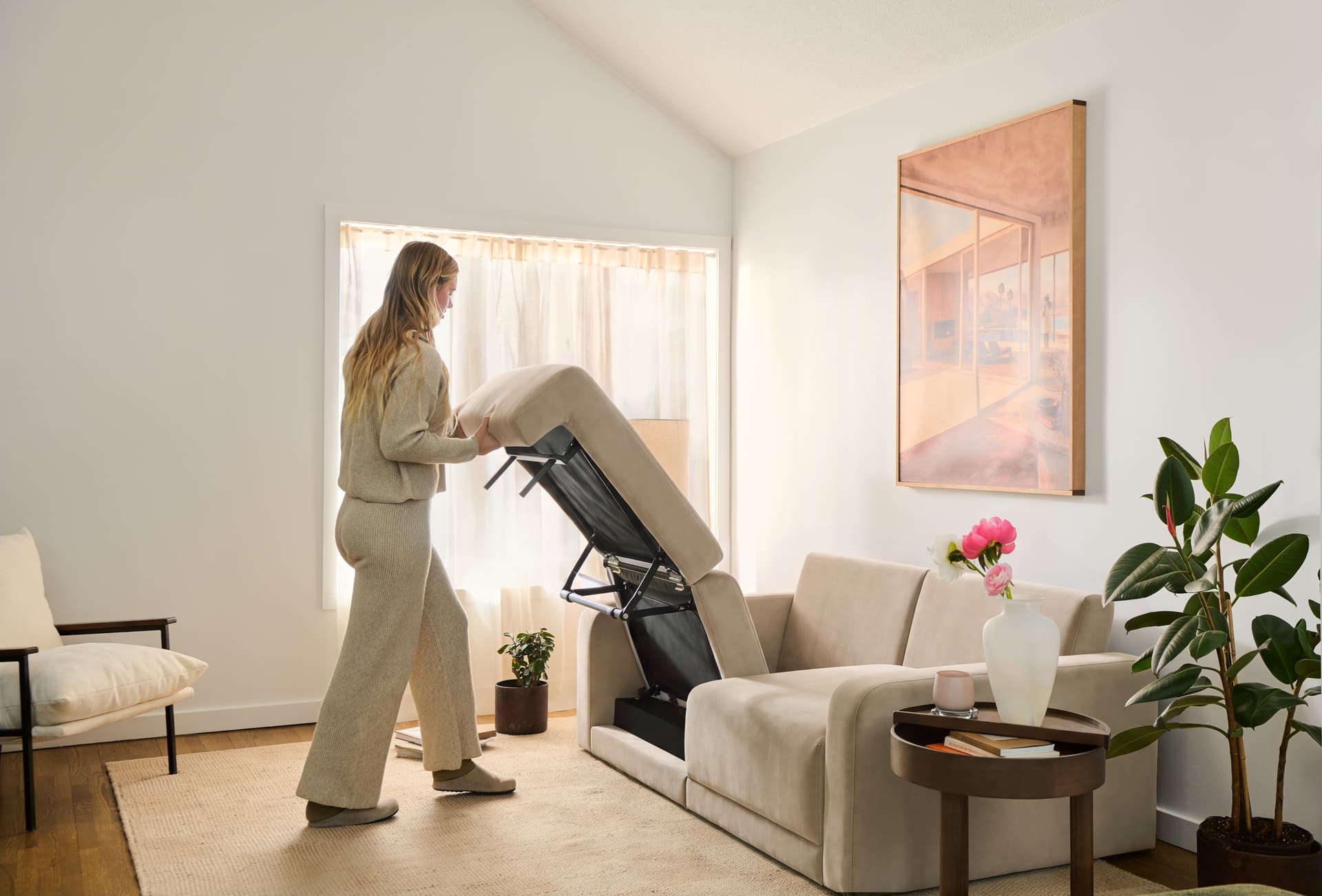
A study in an Australian apartment may also serve as a lounge and guest bedroom. A sofa bed, wall bed, daybed or inflatable mattress can each work; the right answer depends on how the room is used during the day and how often guests stay.
Short answer: Choose a sofa bed if you need genuine everyday seating and a ready guest bed in the same footprint. Choose a Murphy bed when folded depth and a wall-based installation matter most; a daybed when a compact, bed-like seating form suits the room; or an air mattress when guests visit rarely and extra seating isn't needed.
On This Page
- Compare the job each option does best
- When a Murphy bed is the better purchase
- When a daybed fits better
- When an air mattress is enough
- When a sleeper sofa earns its place
- A room-use decision tree
- An example in an Australian home
- The bottom line
Compare the job each option does best
Compare the job each option does best
| Guest-sleep solution | Daytime role | Night-time setup | Main compromise |
|---|---|---|---|
| Sleeper sofa | Real sofa seating | Unfold/extend, then add bedding | Takes floor depth when open; a compromise versus a dedicated mattress |
| Murphy / wall bed | Frees floor when closed; can integrate cabinetry | Lower the bed according to its mechanism | Requires suitable wall/cabinet installation and a clear lowering zone |
| Daybed | Bed-like bench/lounger | Usually add or adjust bedding | Often smaller seating capacity; not always a traditional sofa feel |
| Air mattress | Stores away between visits | Inflate, make bed, deflate later | Setup/packing; floor-level access and air retention vary by design |
These aren't rankings. They solve different problems. A generous living room that needs family seating has different priorities from a small room used almost entirely as a study.
When a Murphy bed is the better purchase
Cozey's founder identifies two compelling benefits of a Murphy bed. First, the closed unit can project less deeply into the room than a sofa, leaving more usable daytime floor space. Second, it can form part of an attractive wall of cabinetry, shelving or decorative storage.
That makes a wall bed worth considering when the space is mainly used for floor activities or work, rather than lounging. It can also be a strong fit when a dedicated mattress feel is the top priority for regular sleeping.
The trade-offs: a Murphy bed usually needs a suitable installation location, the correct wall anchoring or manufacturer-approved support, and enough space to lower the bed. Not every model includes storage, and a closed wall bed does not provide sofa seating unless a hybrid design is purchased. Always follow the manufacturer's installation requirements; don't treat a heavy wall bed as a freestanding DIY cabinet.
When a daybed fits better
A daybed is a distinct interior look, often with a smaller overall footprint than a conventional sleeper sofa. It can be effective in a reading nook, small spare room or study where sitting is occasional and the room doesn't need seats for several adults.
A daybed can also feel straightforward because the sleeping surface is already bed-like, but that depends on whether it uses a conventional mattress or a custom cushion. Some need no conversion; others include trundles that require additional floor space. Measure any pull-out trundle as carefully as a sleeper sofa.
When an air mattress is enough
For someone who hosts overnight guests only a handful of times per year and does not need another sofa, Cozey's founder would recommend considering an air mattress. It can be put away completely between visits, leaving the room free for normal use.
Its drawbacks depend on the mattress: inflation time, pump access, puncture risk, floor clearance and the possibility of gradual firmness change overnight. A thicker raised air mattress can improve access, but it still requires complete floor space when inflated and a clean, dry storage area when packed.
When a sleeper sofa earns its place
A sleeper sofa is most compelling when the room genuinely needs two distinct functions. If guests stay a few times a month and the space is used for sitting every day, a sofa bed can be more useful than a stored air mattress or a wall bed that never offers a comfortable place to gather.
Cozey's systems illustrate different versions of that trade-off:
- Neptune: relatively firm, upright everyday seating; elevated sleeping surface; storage inside every sleeper seat.
- Orian: lower, deeper sofa seating; an approximately Queen-size bed from two sleeper seats; storage through separate modules.
- Atmosphere Sleeper: softer, thicker sleeping cushioning; highly customisable styling and modules; lower sleeper extension.
Cozey does not recommend any of these as an every-night mattress replacement for many years. If a room is primarily for nightly sleeping, start by evaluating a dedicated mattress and a Murphy or conventional bed.
A room-use decision tree
Decision diagram: begin with how the room is used most days, rather than choosing furniture by product category alone.
An example in an Australian home
If a study needs a comfortable lounge on most days and a spare bed occasionally, a sofa bed can serve both purposes. If clear daytime floor area matters more than seating, a wall bed may be the better option. If guests arrive only once or twice a year, an inflatable mattress may be adequate. In all cases, measure the furniture open, not only closed.
The bottom line
The most helpful question isn't “Which guest bed is best?” It's “What does this room need to do on the other 350 days of the year?” Match the furniture to that answer.
Editorial references and product specifications